The Zero Surprise Build
Most construction problems are not site problems. They are decisions nobody wrote down — a finish never specified, a change never priced, a date that slipped three weeks before anyone said so. Seven stages, each closed in writing before the next begins.
Reality Check
Before any drawing, we stand on your plot. Soil condition, access for material trucks, levels, setbacks, what the neighbours have built and how it affects you. Then the harder conversation: what your budget actually builds, in square feet and in specification.
A written summary of the plot assessment, an indicative cost range and a realistic timeline.
What this prevents: discovering at foundation stage that the plot needs filling, or at finishing stage that the budget ran out two floors ago.
Design Freeze
Architectural and structural drawings are completed and signed off by you. Room sizes, openings, levels, staircase, elevation — settled on paper while changing them still costs nothing but a conversation.
After this point, changes are priced before they are executed. Not refused, and not quietly absorbed into the schedule either — priced, in writing, so you decide knowing the number.
Signed architectural and structural drawings, submitted to the authority for sanction.
What this prevents: the mid-build change that nobody costs, which surfaces as a disputed bill four months later.
Scope Lock
An itemised BOQ and a brand-level specification sheet. Not "quality cement" — OPC 53. Not "good wiring" — Havells or Polycab FRLS with Legrand switches. Every allowance stated as a figure, so you know exactly what you are choosing within.
The exclusions list is issued at the same time, before the advance, not after. If something is not in your package, you learn it now.
Itemised BOQ, specification sheet, exclusions list and the contract — all before any money moves.
Here are those three documents, as they go out. The BOQ below is a real one — a house under contract at Wave City, Ghaziabad. The client's name and the date are withheld. Nothing else on it has been changed, including the quantities.
A BOQ is taken off from your own drawings, so the quantities on it are your house's and nobody else's — the earthwork measured from your plot's levels, the concrete and steel from your structural drawing, the allowances from your contract. The specification sheet and the exclusions list, by contrast, are identical for every client we build for. That is exactly why we can publish them.
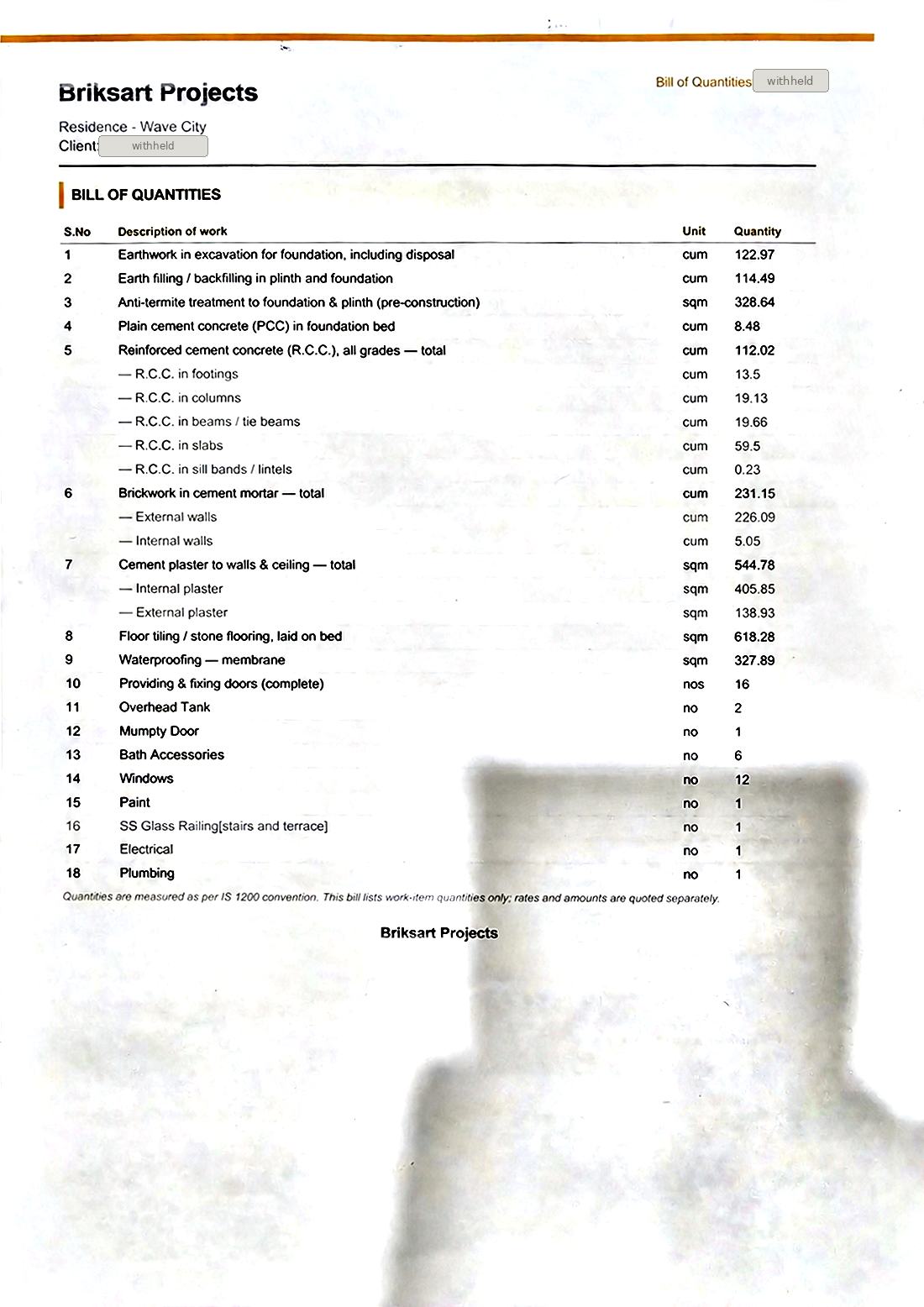
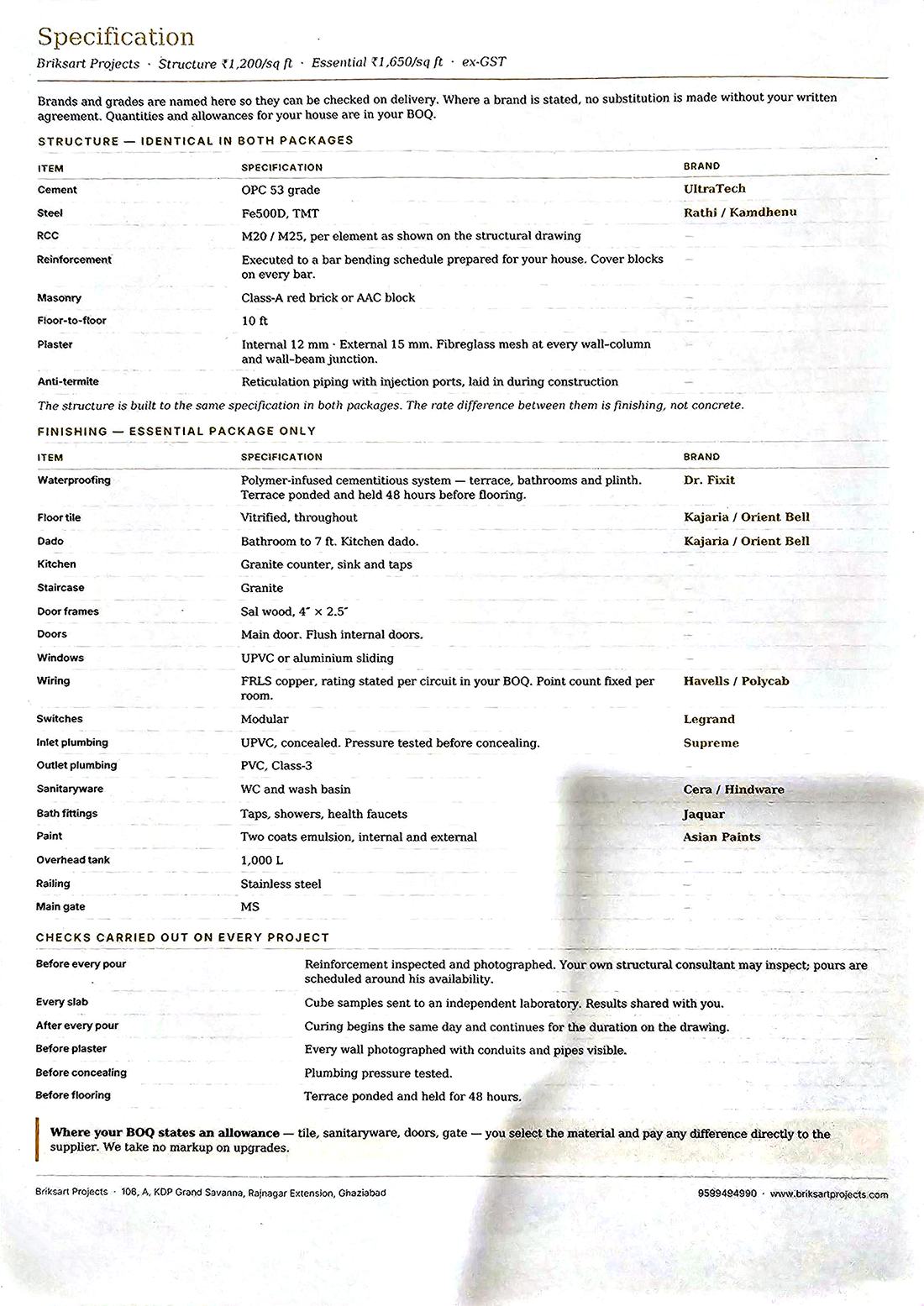
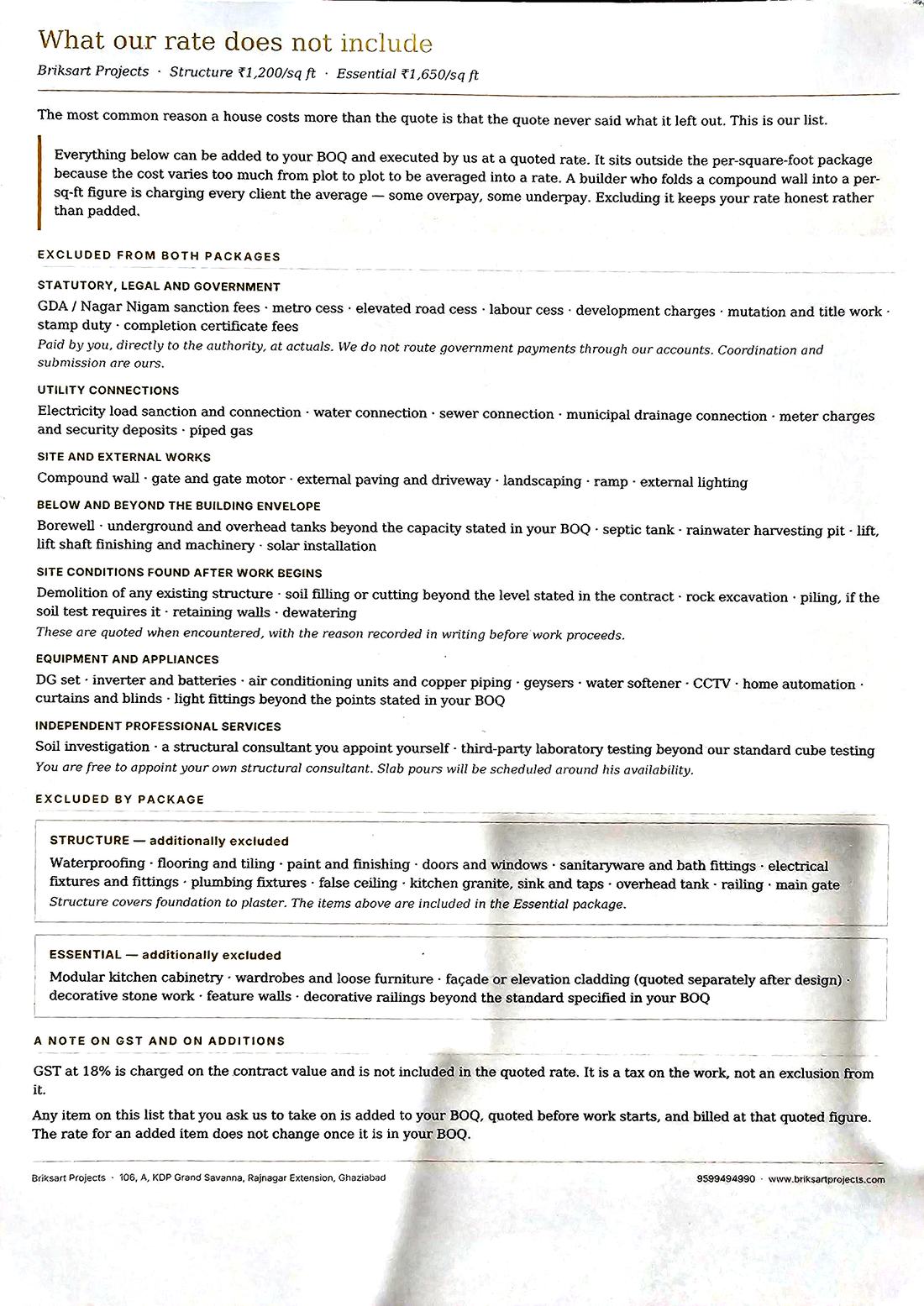
Click any document to open it full size.
What this prevents: the per-square-foot rate that quietly becomes a higher final bill once everything excluded from it arrives as an extra.
Structure Up
Excavation to slab. Reinforcement is checked against the structural drawing before every pour — bar diameter, spacing, cover, lap lengths — and photographed. If you have appointed your own structural consultant, pours are scheduled around his availability so he can inspect before concrete goes in.
This is the part of your house that cannot be corrected later. Everything after it is finishing; this is the house.
Stage photographs of reinforcement and each pour, and material test reports where applicable.
What this prevents: structural shortcuts that are invisible once concrete is poured and expensive beyond repair once discovered.
Selection Sign-off
Tiles, sanitaryware, fittings, paint — chosen by you against the allowance stated in your BOQ, with the choice recorded and dated. Where you select above the allowance, you pay the difference directly to the supplier. We take no markup on upgrades.
A dated selection record against each allowance line in the BOQ.
What this prevents: a mason choosing your bathroom tile on a Tuesday because nobody had decided and the work could not wait.
Zero Drift
Weekly progress reporting against the committed schedule — what was planned, what was completed, what is next, with photographs. When something slips, you are told in that week's report, with the reason and the revised date.
This matters most if you are not in the country. A delay you learn about in week three is a problem to solve. The same delay discovered in month six is a different conversation entirely.
A weekly written report with site photographs and schedule status.
What this prevents: the silence that lets three weeks become three months while every phone call says work is going on.
Clean Handover
A joint snag walk, the list closed, and the documents handed over — drawings as built, sanction papers, material test reports, manufacturer warranties for fittings and appliances, and your own warranties in writing: 20 years structure, 3 years waterproofing, 90 days workmanship.
The final 2.5% of the contract is held for six months past handover. We remain financially in the project after you move in, which is the point of structuring it that way.
Closed snag list, complete document set, and written warranties.
What this prevents: the builder who stops answering the phone the week after the last payment clears.
Why it is structured in stages
Every stage produces a document, and the next stage does not begin until that document exists and you have seen it. That is the whole mechanism. It is not a promise about care or quality — it is a sequence where the things that usually go wrong have to be decided in writing before work can continue past them.
It also means that if you are abroad or working six days a week, you are not relying on remembering to ask. The reporting comes to you.
Start with a conversation
Tell us where the plot is, what you want built and roughly when. We will tell you what it costs and what the first steps are.
Start the process
Tell us where you are — drawings, sanction, or ready to build — and we will tell you what the first stage looks like.